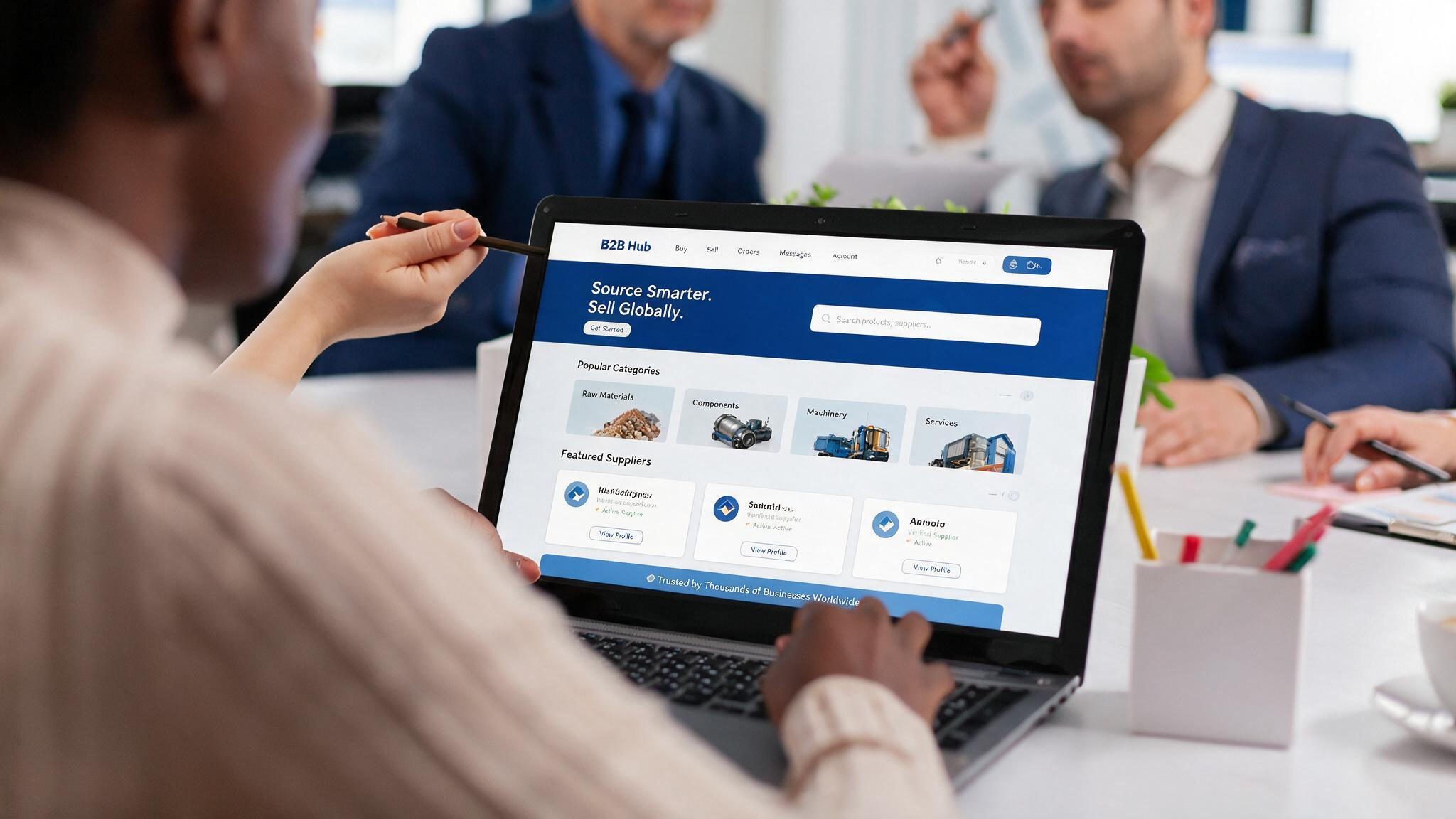
An e-procurement marketplace solution is a platform that digitizes a company's purchasing cycle by bringing its approved suppliers together on an internal marketplace environment. Employees submit their purchase requests within a governed framework, with catalogs, approval workflows and end-to-end traceability.
Most executives know the principle. They underestimate the scope. An e-procurement marketplace solution is not just about digitizing a purchase order. It covers the entire purchasing process, from the expression of a need to supplier payment. This is what we call procure-to-pay.
E-procurement refers to the digitization of internal purchasing processes. A purchasing marketplace adds a layer of orchestration. Multiple suppliers expose their catalogs on the same platform, and employees order the way they would on a consumer marketplace, but within a governed, professional framework.
The difference lies in the number of suppliers and how they are exposed. A standard e-procurement tool manages suppliers one by one. An e-procurement marketplace solution brings them together on a shared interface, with merchandising rules, price comparisons and a unified buying experience. For a company working with hundreds of suppliers on indirect purchases, this shift in scale changes everything.
The word marketplace entered the e-procurement definition because B2B buying has moved closer to the B2C model. Employees who order at work expect the same simplicity they find on a consumer marketplace. A solution that does not deliver this experience will be bypassed. Maverick buying, or off-contract purchasing, is the direct symptom of this bypass.
Indirect procurement covers everything that does not go directly into the product being sold. Office supplies, software licenses, maintenance, occasional services, IT equipment. According to Spendesk, it represents 10% to 25% of a company's revenue and 15% to 50% of total purchasing volume. Weproc places the average around 50% of total spend.
Up to 79% of companies lack a global view of their indirect procurement, according to research cited by Fluxym. When four out of five companies cannot say precisely what they buy, from whom and on what terms, spend becomes unreadable.
The disorder carries a price tag. According to La Lettre des Achats, cited by Spendesk, a single indirect procurement order costs 73 euros in an unoptimized process, compared to 36 euros in an optimized one. The gap, over 50%, sits in administrative processing cost, not in product price.
The distributor Unite illustrates how concentrated the problem is. Class C purchases represent about 20% of spend but involve nearly 80% of suppliers. Many transactions, many contacts, low individual amounts. This is the ground where nobody looks.
Starting September 1, 2026, the reception of electronic invoices becomes mandatory for all VAT-registered companies, according to Service-Public / Entreprendre. Large companies and mid-size enterprises must also issue them by that date. Small businesses and micro-enterprises have until September 1, 2027.
This deadline makes visible what stayed in the shadows. Digitizing invoices without mastering your purchase orders produces unusable data. It is an opportunity to take back the entire chain, from the expressed need to the payment.
The first building block of an e-procurement marketplace solution is the catalog. Each approved supplier exposes its products and negotiated prices on the platform. Employees no longer need to hunt for the right supplier or the right price. They order within an already defined framework.
The number of suppliers managed on the platform is what separates a simple tool from a marketplace solution. When hundreds of suppliers coexist on the same interface, with structured catalogs and merchandising rules, you cross into the purchasing marketplace logic.
A purchase request is no longer an email or a spreadsheet. It is entered directly on the platform, which automatically applies validation rules based on amount, category or department. Each type of spend has its own approval circuit. Approvers step in at the right moment, without follow-ups and without lost emails.
This automation is what distinguishes an e-procurement marketplace solution from a standard B2B e-commerce platform. The purchasing process is governed, not merely digitized.
Procure-to-pay, or P2P, covers the entire purchasing cycle. According to Weproc, a typical P2P system includes the request, the approval, the order, the receipt, the invoice reconciliation and the payment. Each step is digitized and traced.
The value of a unified platform, rather than tools bolted together, lies in continuity. When the request, the approval, the order, the receipt and the invoice flow through a single stream, the data is reliable end to end. This continuity is what produces both savings and compliance.
Punchout allows a buyer to access a supplier's online catalog from their own purchasing environment, then bring their cart back into the internal approval workflow, without double data entry. It is the meeting point between e-procurement and the marketplace. It connects external supplier catalogs to the internal buying environment.
A dashboard aggregates data from all orders, approvals and invoices. Who ordered what, from whom, when, at what price, with which validation. This traceability turns indirect procurement from a blind spot into a manageable category.
According to a Synapscore study cited by Spendesk, procurement performance management ranks in the top 3 priorities for 64% of Chief Financial Officers. The dashboard is the tool that makes this management possible.
Sector analyses and feedback from companies, compiled by Weproc, show that a structured approach to indirect procurement can cut associated costs by 15% to 25%. On a category that accounts for half of all purchasing, the impact is not trivial.
The reduction does not come from product prices. It comes from the administrative cost of each order, the number of active suppliers, duplicates and invoice disputes.
The platform enforces the company's purchasing rules automatically. Approval thresholds, restricted categories, approved suppliers. Maverick buying recedes not through constraint, but because the governed path becomes the simplest one.
The setup of these rules is configurable. You start with two or three high-stakes categories, measure, then expand. A platform that is too rigid will be bypassed. A flexible one adapts to the real organization.
Indirect procurement is carried out by non-procurement staff. A project manager, a site manager, a marketing team member places orders without being a purchasing professional. The success of an e-procurement marketplace solution depends on their adoption.
The buying experience must be comparable to a consumer marketplace. Simple, fast, intuitive. Anything that complicates employees' daily work produces the opposite of the intended effect. Maverick buying comes back through the window.
Electronic invoicing becomes mandatory in 2026. An e-procurement marketplace solution that integrates this requirement from the design stage avoids scrambling to comply. Data, structured end to end, flows into accounting systems without re-keying.
Not every company needs a full platform. A small business working with twenty suppliers can get by with spreadsheets. Beyond that, disorder sets in and administrative cost explodes.
The shift is justified when the number of indirect procurement suppliers exceeds a hundred, when orders multiply without a framework, or when regulatory compliance demands a level of traceability that current tools cannot produce.
Faced with a project that touches half of all purchasing, the temptation is to tackle everything at once. This is the best way to do nothing. The right approach is the opposite. Start small, but start in the right place.
Map your indirect spend first. Who buys what, from how many suppliers, within or outside a framework. This audit reveals the two or three categories where the stakes are highest. You test catalogs, workflows and traceability there without putting the core activity at risk. The gains fund and legitimize the expansion to the rest.
Use the 2026 deadline as a trigger. The electronic invoicing obligation is an opportunity to lay out the entire chain, from order to invoice. Turning a regulatory constraint into the starting point of a broader reclaim of control.
A solution that does not talk to your ERP recreates double data entry, exactly what you set out to eliminate. Integration is the first criterion. Order, receipt and invoice must talk to each other.
If the company works with major suppliers that have their own catalogs, punchout is essential. It eliminates double entry and guarantees data consistency.
Workflows must fit the real organization, not impose a generic straitjacket. Thresholds, approvers, budget rules. The flexibility of configuration is what separates a professional solution from a basic tool.
A powerful but daunting platform will be bypassed. Ease of use is not a luxury, it is the condition of control. Employees must prefer the platform to email.
The solution must support growing volume without a full replatform in two years. The choice between a B2B marketplace, B2B e-commerce and e-procurement depends on the company's trajectory. To go further, you can contact the Uppler team and request a demo of the e-procurement platform.
It is a platform that digitizes a company's purchasing cycle by bringing its approved suppliers together on an internal marketplace environment. It covers procure-to-pay, from the purchase request to supplier payment, with catalogs, approval workflows and end-to-end traceability.
E-procurement digitizes internal purchasing processes. A purchasing marketplace adds a layer of orchestration where multiple suppliers expose their catalogs on a shared interface. Punchout is the bridge between the two approaches.
The shift is justified when the number of indirect procurement suppliers exceeds a hundred, when orders multiply without a framework, or when regulatory compliance demands a level of traceability that current tools cannot produce.
Yes. Feedback compiled by Weproc shows that a structured approach to indirect procurement can cut associated costs by 15% to 25%. The reduction comes from administrative processing cost, not from product prices.
A compliant e-procurement marketplace solution integrates the reception and issuance of electronic invoices, mandatory from September 1, 2026 for all VAT-registered companies. Data, structured end to end, flows into accounting systems without re-keying.
1-month launch with our all-in-one solution
Specialized in B2B e-commerce
Integration team to make your project easier

Morgan Clark
Platform manager at Label Corner
"Customer service is highly responsive and the plateform is easy to use.
The solution has a great adaptability, great value for money and enables a fast implementation"